How to Tell the Difference of Leopard and Cheetah: A Safari Spotter’s Guide
Ever seen a spotted big cat and asked yourself: is that a leopard or a cheetah? Don’t worry, you’re not alone. These two feline superstars are often confused. But knowing their differences makes your game drives far more thrilling. In this safari spotter’s guide, you’ll finally master the difference of leopard and cheetah. So, let’s get started!
Physical Differences Between Cheetahs and Leopards
Body Shape and Size
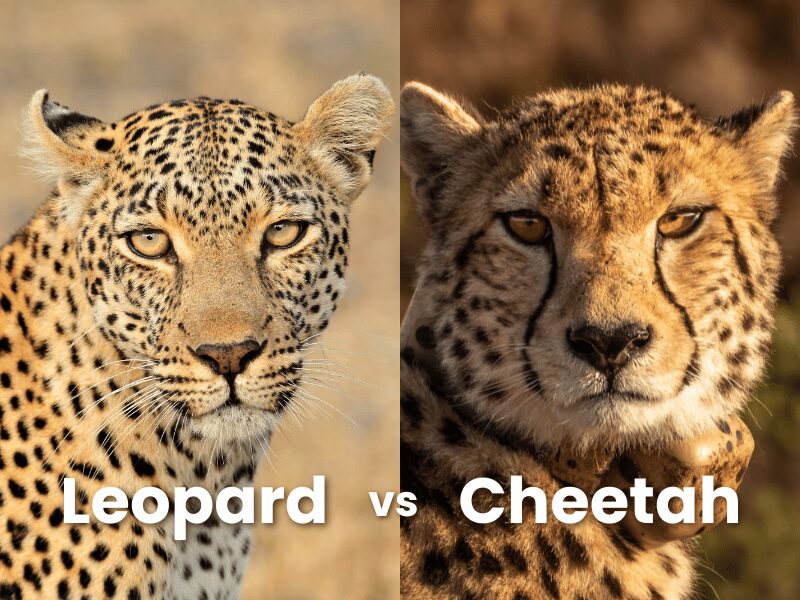
At first glance, both cheetahs and leopards look similar. After all, both have golden coats and dark spots. But their body shapes reveal their different lifestyles.
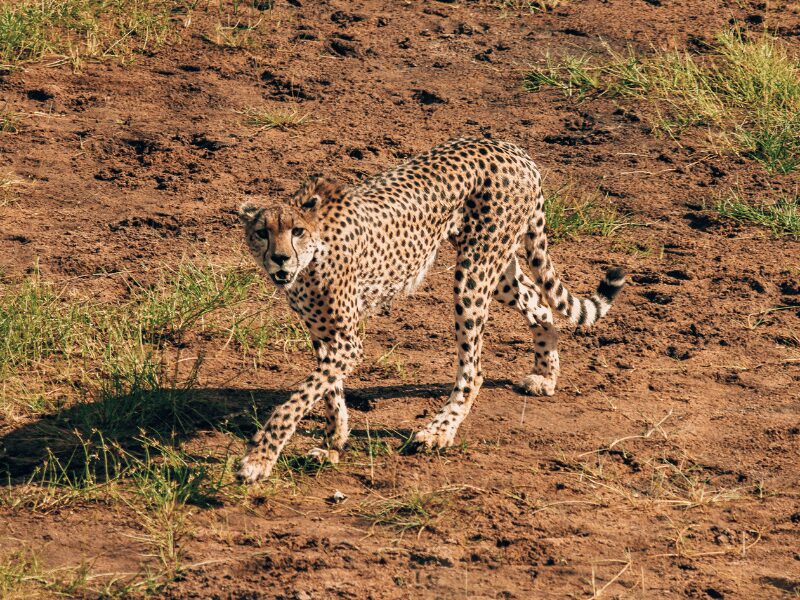
Cheetahs are built for speed. They have slim and lightweight bodies. You will notice long legs, a narrow waist, and a deep chest. Think of them as the sports cars of the savannah.
Leopards, on the other hand, are more muscular. Their bodies are powerful and compact, with relatively shorter legs and a broader build. This strength helps them climb trees while carrying heavy prey (an ability that cheetahs lack).
In terms of size, leopards are generally heavier. They weigh between 30 to 90 kg (66 to 198 lbs). Cheetahs are lighter, around 21 to 72 kg (46 to 159 lbs).
Head, Face, and Tail Features
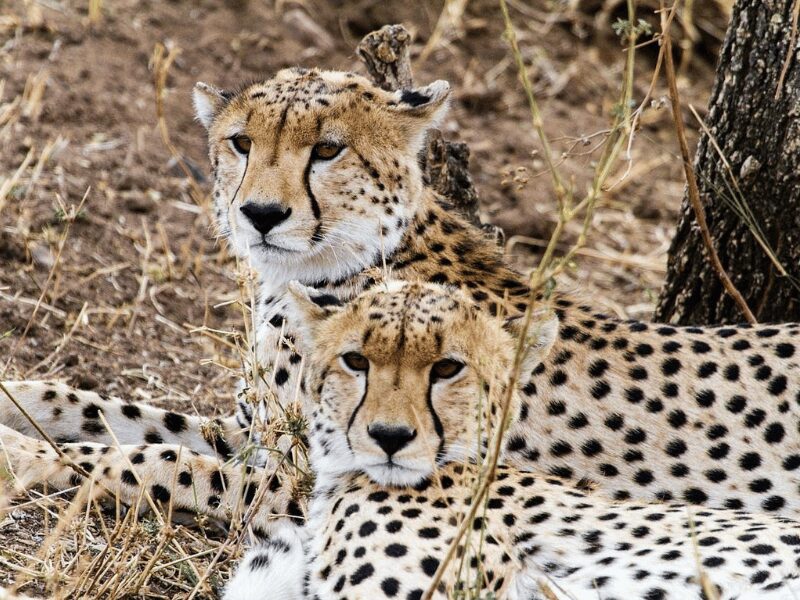
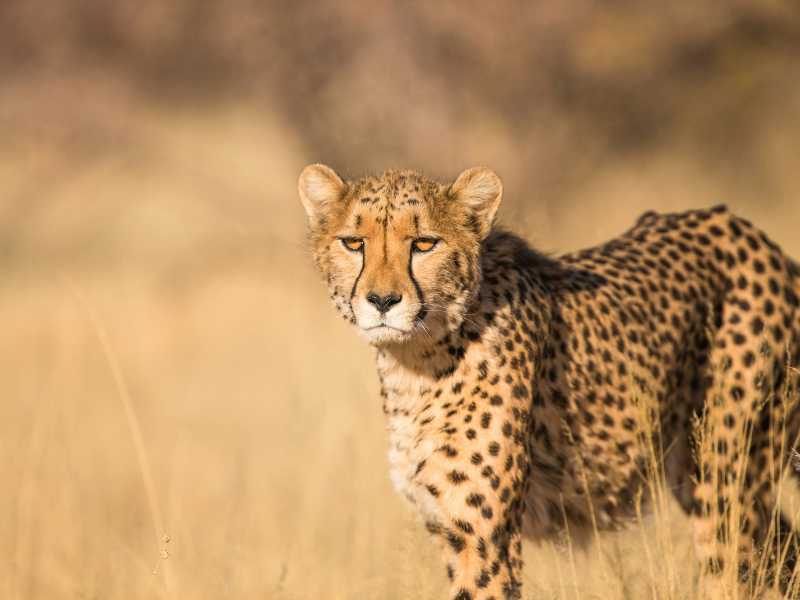
Another easy way to tell the difference of leopard and cheetah is by looking at their faces. Cheetahs have small, rounded heads. They usually have distinctive black “tear marks” running from the inner corners of their eyes down to the sides of their mouths. These marks reduce glare from the sun and help them focus when sprinting after prey.
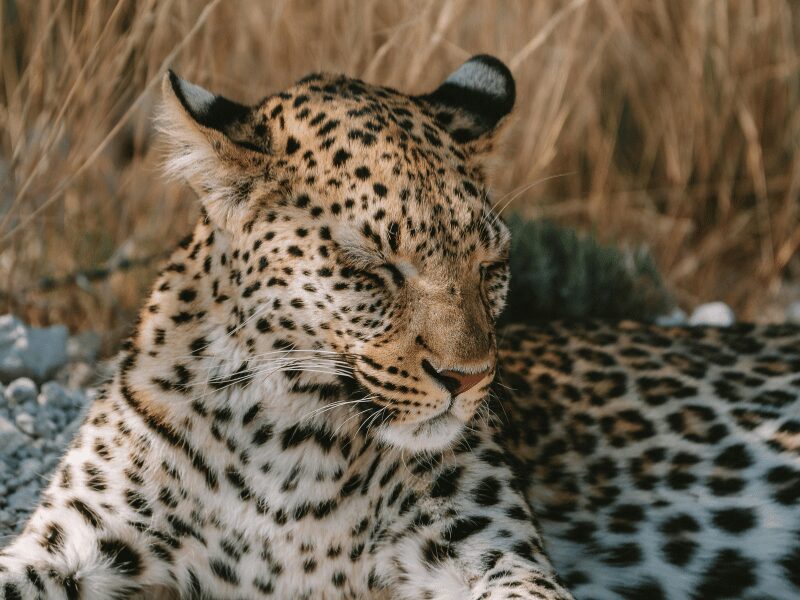
Leopards lack these tear marks. Instead, their faces are broader and more robust. Rosette-shaped spots cover their heads and bodies. Their eyes are a striking golden color (and have an intense predatory gaze!).
When it comes to tails, cheetahs have long and flat tails with black rings and a white tip. These act like rudders for balance while running at top speeds. Leopards’ tails are also long but thicker. They have more solid black spots that help them maintain balance when climbing trees.
Cheetah vs. Leopard Behavior and Habitat
Hunting Style and Speed
Cheetahs and leopards have completely different hunting styles.
Cheetahs rely on their incredible speed to catch prey. They are the fastest land animals, reaching up to 112 km/h (70 mph) in short bursts over distances of 200 to 300 metres! Their hunts usually happen during the day, especially early morning or late afternoon, to avoid competition with other predators. You’ll often spot cheetahs in open grasslands.
Leopards, in contrast, are stealthy ambush hunters. They stalk their prey closely and then pounce with power. While cheetahs tire quickly after a chase, leopards use their strength to drag prey up into trees, away from scavengers. They hunt mostly in low light. So they’ll be harder to spot on a daytime safari.
Where You’ll Find Them
Cheetahs prefer open savannahs where they can take advantage of their speed. In East Africa, you’re most likely to see them in areas like the Serengeti in Tanzania or the Maasai Mara in Kenya. Here, wide and flat landscapes make perfect hunting grounds.
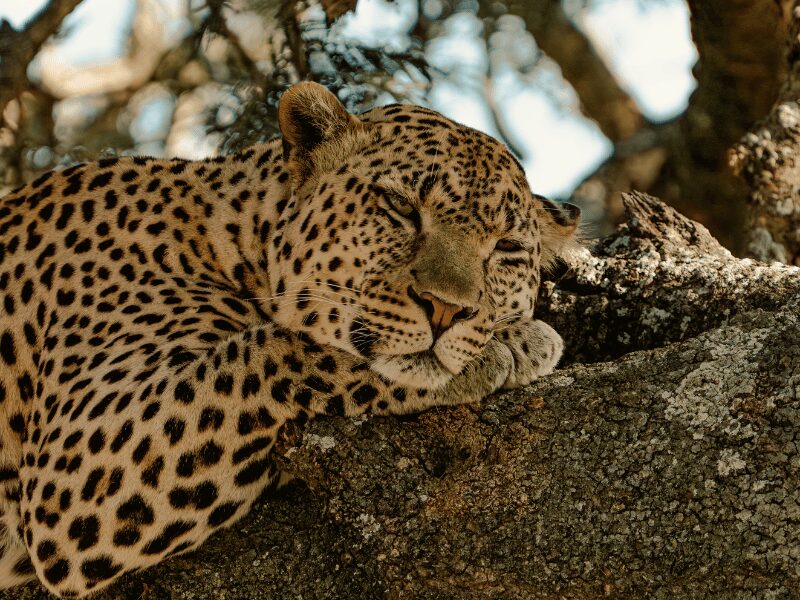
Leopards, however, are highly adaptable. They live in a variety of habitats: savannahs, forests, woodlands, even mountainous regions. Their tree-climbing skills mean you might see them draped over a branch or hidden in dense foliage. In places like the Serengeti, Kruger National Park, or South Africa’s Sabi Sands, leopards are often spotted resting on tree limbs.
Interested in learning more about Africa’s big cats? Check out: Rare White Lions in the Wild
Habitat: Where Each Cat Lives
Where Cheetahs Live
Cheetahs prefer open savannahs and flat grasslands where they can use their speed without obstacles. In East Africa, the Serengeti in Tanzania and the Masai Mara in Kenya are the most reliable places to see them. Open plains with good sightlines are their natural hunting ground.
Globally, cheetahs are wide-ranging but increasingly rare. Sub-Saharan Africa holds the largest populations. There is also a small, critically endangered population of Asiatic cheetahs surviving in Iran — a detail that surprises most people who think of cheetahs as exclusively African.
Where Leopards Live
Leopards are among the most adaptable large predators on earth. They live in savannahs, dense forests, rocky hillsides, bushy thickets, and mountainous regions. If there is cover to hide in and trees to climb, leopards can make it work. Their range extends across sub-Saharan Africa, parts of North Africa, and through much of Asia.
This adaptability is part of why leopard sightings feel different from cheetah sightings. A cheetah in the open plains is doing what a cheetah does. A leopard materializing from what looked like an empty patch of bush is doing something else entirely.
Best places to see leopards: Kruger National Park and Sabi Sands in South Africa, the Serengeti in Tanzania, and the Masai Mara in Kenya. Sabi Sands in particular has one of the highest leopard densities in Africa — off-road driving and experienced trackers make sightings significantly more reliable there than in the main park.
Where to See Cheetahs and Leopards on Safari
For Cheetahs
Tanzania (Serengeti) — The southern and central Serengeti plains give cheetahs the open terrain they need. The best window is the dry season (June to October) when the grass is shorter and sightings are more reliable. The Serengeti also has one of the healthiest cheetah populations in East Africa.
Kenya (Masai Mara) — The Mara’s open savannah is ideal cheetah country. The reserve’s smaller size compared to the Serengeti means wildlife density is higher, and cheetahs are spotted regularly on morning drives. Late July through October, during the Great Migration period, is peak season overall.
Botswana (Okavango Delta fringe and Savuti) — Less commonly associated with cheetah sightings than East Africa, but the open floodplain edges of the Delta and the Savuti area in Chobe support healthy cheetah populations. The exclusivity of Botswana camps means a sighting here tends to feel more private.
For Leopards
South Africa (Sabi Sands) — The strongest recommendation for anyone whose primary goal is a leopard sighting. Sabi Sands has one of the highest densities of habituated leopards in Africa, and off-road driving means guides can follow individual animals through thick bush. Night drives here are particularly productive.
Tanzania (Serengeti) — Leopards are present throughout the Serengeti but are harder to find than lions or cheetahs given their preference for cover. The kopjes (rocky outcrops) in the central Serengeti are reliable resting spots, particularly in the middle of the day.
Kenya (Masai Mara) — The Mara has a good leopard population. Sightings tend to happen in the riverine forest along the Mara River and in the scattered tree lines across the reserve. Early morning is your best window.
Botswana (Okavango Delta) — Leopards in the Delta are more elusive than in South Africa, but the mokoro channels and forested islands create exactly the kind of habitat they prefer. A sighting here is genuinely earned.
The Spot and Pattern Differences Explained
Cheetah Spots vs. Leopard Spots
One of the easiest ways to tell the difference between a leopard and a cheetah is by looking at their spots. Cheetahs have solid black round or oval spots. These are evenly scattered across their tan coats. Each spot is separate and distinct. This gives cheetahs a clean, polka-dotted appearance. Their underbellies are white without any spots, and their tails have black rings ending with a white tuft.
Leopards, on the other hand, have more complex markings called rosettes. These are clusters of black spots arranged in circles with a lighter brown center (somewhat a rose-like pattern). Their rosettes vary in size and shape across different regions, but unlike cheetah spots, they are not solid. Their tails also carry rosettes and end with a dark tip.
Why Spot Differences Matter
Did you know these spot differences have survival advantages, too? Cheetah spots provide excellent camouflage in open grasslands. This helps break up their outline as they stalk prey. Their tear marks also reduce glare, which helps with hunting under the sun.
For leopards, rosettes help them blend into the dappled light of trees. This camouflage is essential for their ambush hunting technique and for hiding from competitors. Their spotted coats make them nearly invisible in thick vegetation.
By keeping these differences in mind, you will be able to identify them on safari. Plus, you will have insight into how each cat is adapted to its environment.
Can a cheetah and a leopard mate?
It’s a reasonable question given how similar they look, but no. Cheetahs and leopards belong to different branches of the big cat family tree. Their DNA is too far apart for interbreeding, and there are no cheetah-leopard hybrids in the wild or in captivity. Their genetics don’t align, and their behaviors don’t either. These are two separate species that happen to share the same landscape.
Fun Facts About Cheetahs and Leopards
Before we wind up, we want to share some fun facts about cheetahs and leopards. Keeping these in mind will make you the more knowledgeable one on your safari!
Did You Know?
Both cheetahs and leopards are fascinating creatures with their own unique abilities that make them safari favourites!
Cheetahs can’t roar, but leopards can
Unlike other big cats, cheetahs don’t have the voice box structure needed to roar. Instead, they chirp, purr, hiss, growl—all those things—to communicate. Leopards, on the other hand, have a deep and rasping roar. You can think of this as the sound of a saw cutting through wood.
Leopards drag their prey up trees
Leopards are incredibly strong. They are known for hauling prey heavier than themselves up into trees. This keeps their meal safe from scavengers like hyenas and lions. If you spot an antelope carcass draped over a branch, a leopard is likely nearby guarding its feast.
Cheetahs have semi-retractable claws for grip
Unlike leopards that have fully retractable claws, cheetahs have claws that remain partly exposed. This feature gives them extra traction during high-speed chases (much like the spikes on running shoes).
Frequently Asked Questions
Is a leopard and a cheetah the same thing?
No. They are two completely different species. Both have spotted coats and live across parts of Africa, which is where the confusion comes from, but they are not closely related within the big cat family. Cheetahs are built for speed and hunt in daylight on open plains. Leopards are built for stealth and strength, hunt at night, and are equally at home in dense forest as in open savannah.
Can a cheetah and a leopard mate?
No. Cheetahs and leopards belong to different branches of the big cat family tree. Their genetics are too far apart for interbreeding, and there are no cheetah-leopard hybrids in the wild or in captivity. They share landscape but are separate species with different behaviors, biology, and social structures.
Which is more dangerous, a cheetah or a leopard?
Leopards. Cheetahs are not considered particularly dangerous to humans and will typically retreat from confrontation. Leopards are far more powerful relative to their size, hunt at night, are highly opportunistic, and in areas where they have lost their natural fear of humans, they can be genuinely dangerous. This is part of why guides take leopard sightings more seriously than cheetah sightings in terms of keeping distance.
Which is harder to see on safari — a cheetah or a leopard?
It depends on the destination. In the Serengeti or Masai Mara, cheetahs are actually easier to spot because they hunt in the open during daylight. Leopards, given their nocturnal habits and preference for cover, can be harder to find in the same parks. In South Africa’s Sabi Sands, the reverse is often true — habituated leopards and off-road access make leopard sightings surprisingly reliable, sometimes multiple per day, while cheetahs are rarely seen.
What is the easiest way to tell them apart quickly?
Look at the face first. If you see tear marks — black lines running from the eyes down to the mouth — it is a cheetah. No other big cat has them. If there are no tear marks and the spots are clustered into irregular rosette patterns rather than solid dots, it is a leopard.
Quick Reference: Cheetah vs. Leopard
| Cheetah | Leopard | |
| Build | Slim, lightweight, long-legged | Muscular, compact, powerful |
| Weight | 21 to 72 kg | 30 to 90 kg |
| Spots | Solid round dots | Rosettes (clustered rings) |
| Tear marks | Yes — black lines from eye to mouth | No |
| Hunting Style | High-speed daylight chase | Nocturnal ambush |
| Prey Storage | Does not tree prey | Hauls prey into trees |
| Claws | Semi-retractable | Fully retractable |
| Roar | Cannot roar | Deep rasping roar |
Conclusion
Next time you’re out on a game drive and “spot a spotted cat”, you’ll know exactly what to look for. Remember: cheetahs are the slender speedsters with solid spots and tear marks. Leopards are powerful climbers with rosette patterns.
Understanding the difference of leopard and cheetah deepens your appreciation for their unique roles in Africa’s wild landscapes. So, keep your eyes peeled, your camera ready, and impress your fellow travelers with your spotter skills 😉
Wondering if there are Tigers in Africa? Check out our blog to know more.
If you’re ready to see these majestic cats in action, join us at Good Earth Tours for an unforgettable safari adventure. Let’s chat!