Are There Tigers in Africa? The Surprising Answer
Curiosity, mixed with misconceptions, surrounding tigers in Africa has created much speculation and intrigue. But what is the truth? Are there tigers in Africa? Today, we will answer this popular question, and clear up any misconceptions that have fueled the belief in their presence on the continent.
Why Are There No African Tigers?
To answer this question, we need to go back. Way back.
All modern carnivores evolved between 60 and 35 million years ago, and it is believed that the very first “true cat,” called Proailurus, appeared about 30 million years back.
About 15 million years later, a prehistoric cat known as Pseudaelurus (approximately the size of a cougar) lived in Africa. Later, the now-extinct saber-toothed species evolved there, too.
However, for reasons unknown to tiger experts and scientists, we find that about 2 million years ago, an offshoot of the Felidae family (including leopards, lions, jaguars, pumas, and lynx) caused the cats to migrate into East Asia. Over the next million-and-a-half years, they evolved into tigers.
The Obstacles in the Way
After the tigers were established in Asia, they never returned to Africa, though there is no definite reason as to why. One theory suggests that when tigers started living in Asia, they became used to their ecosystems, environments, and availability of prey. They were thriving, and there was no reason to take the arduous journey back to Africa, where they would have to face new environments and predators.
Another theory is that over a period of about a million years (and more), the impacts of glacial fluctuations and the slow erosion of land bridges between the two continents made it super difficult (if not impossible) for tigers to return.
In order to travel from Asia to Africa, the ancestors of the tigers would have to cross what is today known as the Middle East. When they first made the journey, that section of the world was a lush savanna, but with time, it turned into an arid, dry desert, making the return journey nearly impossible due to the lack of food and water.
Could Tigers Survive In Africa?
The myth of African tigers has continued for over two million years. One question (apart from are there tigers in Africa?) is whether tigers could actually survive on the continent today.
Again, the answer is completely hypothetical. A theory suggests that considering the fact lions, leopards, and cheetahs all live in Africa, tigers could, too, but, at the same time, there are genuinely valid reasons why they wouldn’t.
In fact, the experiment in 2003, where two South China tiger cubs were introduced to South Africa, proves the point. The founders of a charitable foundation purchased 74,000 acres of land with the intention of rewilding them. However, due to major differences in the ecosystems of China and South Africa, the cubs died.
Given the inability of tigers to withstand differences in the environment and the fact that they would be subjected to aggressive opposition for territory, the answer to the question “Can Tigers Survive in Africa?” lies between “highly unlikely” and “definitely not.”
What Big Cats Actually Live in Africa?
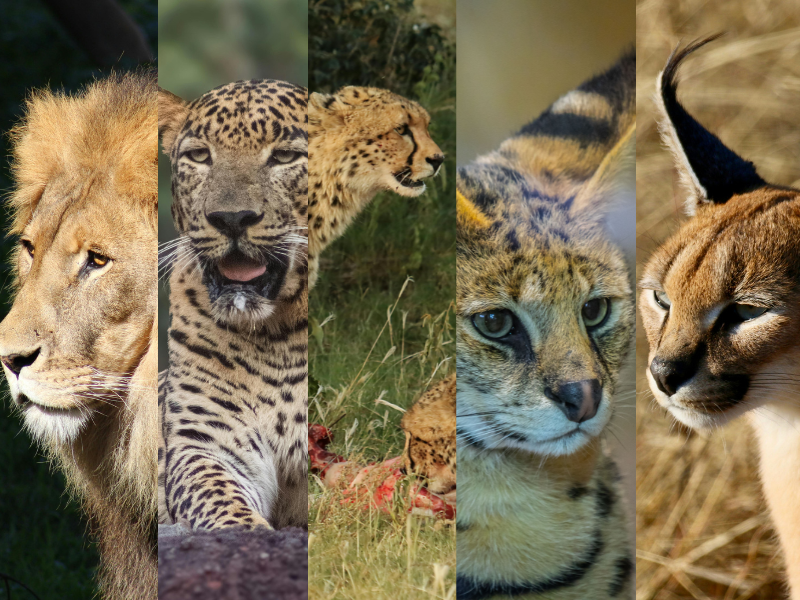
Africa has no tigers, but it has some of the most remarkable wild cats anywhere on earth. Here is what is actually here.
Lion
The African lion is the only truly social wild cat — they live in prides, hunt cooperatively, and occupy the top of the food chain across sub-Saharan Africa’s savannahs and grasslands. A male lion’s roar carries up to five miles. The population has declined significantly over the past century, but the Serengeti in Tanzania, the Masai Mara in Kenya, and Kruger National Park in South Africa all have healthy populations.
Lions are the most reliably spotted of Africa’s big cats on a game drive, particularly in the Serengeti and Masai Mara where the open terrain makes sightings predictable.
Leopard
The leopard is one of the most adaptable large predators on earth. It lives in savannahs, dense forests, rocky hillsides, and semi-arid scrubland across sub-Saharan Africa and parts of Asia. Its nocturnal habits and preference for cover make it harder to spot than lions or cheetahs during daytime drives.
What sets the leopard apart is strength relative to size. It regularly hauls prey heavier than itself into trees to keep the kill away from scavengers. If you see an impala carcass draped over a high branch, a leopard almost certainly put it there.
South Africa’s Sabi Sands Game Reserve has one of the highest densities of habituated leopards in Africa. Off-road driving and experienced trackers make leopard sightings here significantly more reliable than in most national parks.
Cheetah
The fastest land animal, reaching 112 km/h in short bursts. Unlike leopards, cheetahs hunt in daylight on open grassland, relying on acceleration rather than stealth. Their distinctive black tear marks, running from the inner corner of each eye to the mouth, make them immediately identifiable at a distance.
Cheetahs are more vulnerable than leopards they lose a significant portion of their kills to larger predators and have a smaller global population. In East Africa, the Serengeti and Masai Mara are the best places to see them. Their preference for open plains means sightings are often clear and unobstructed.
Caracal
Less well-known than the three above but genuinely striking: a medium-sized cat with a reddish-brown coat and long, tufted black ears that swivel independently to track sound. Caracals are exceptional jumpers — they are capable of leaping several metres into the air to knock birds out of flight.
They are found across Africa, the Middle East, and parts of Asia, in habitats ranging from dry savannah to rocky terrain. Nocturnal and secretive, caracals are rarely seen on a standard game drive. Most sightings happen at night or in remote, less-visited areas.
Serval
A slender, long-legged spotted cat found in wetlands, grasslands, and the edges of forests across sub-Saharan Africa. The serval has the largest ears relative to head size of any cat, giving it exceptional hearing for locating prey in tall grass. It catches rodents, birds, and small reptiles with a distinctive high-pounce technique leaping up and then striking straight down with its front paws.
Servals are occasionally spotted near wetland edges and along drainage lines on East African safaris, particularly in Tanzania. They are not common sightings but memorable when they happen.
African Golden Cat
The least-known of Africa’s wild cats. Roughly twice the size of a domestic cat, the African golden cat lives in the rainforests of Central and West Africa and is almost never seen by safari travelers. Its coat ranges from golden-brown to grey, sometimes with faint spotting. Almost nothing is definitively known about its behavior in the wild.
It does not appear on safari itineraries and is included here primarily for completeness to give an honest picture of what Africa’s cat diversity actually looks like.
Big Cats vs. the Big Five: A Note on the Confusion
These two lists are often confused.
The Big Five lion, leopard, elephant, African buffalo, and rhinoceros — is a grouping that originated with big game hunters, who considered these five animals the most dangerous to hunt on foot. It is a safari planning framework, not a biological classification.
Big cats is a looser term. In its strictest scientific sense, it refers to the genus Panthera: lions, tigers, jaguars, and leopards (the four cats that can roar). In common usage on safari, it usually means lion, leopard, and cheetah. Caracals and servals are considered medium cats or small cats depending on the classification system used.
Two of Africa’s Big Five (lion and leopard) are also big cats. The other three Big Five animals are not cats at all
Where to See Africa’s Wild Cats on Safari
| Cat | Best Destinations | When |
| Lion | Serengeti (Tanzania), Masai Mara (Kenya), Kruger (South Africa) | Year-round; dry season most reliable |
| Leopard | Sabi Sands (South Africa), Serengeti, Masai Mara | Year-round; night drives improve odds significantly |
| Cheetah | Serengeti, Masai Mara, Okavango Delta fringe (Botswana) | Dry season; open plains essential |
| Caracal | Karoo (South Africa), remote Kenyan conservancies | Night drives; rare |
| Serval | Serengeti wetland edges, Ngorongoro Crater floor | Year-round; near water |
Frequently Asked Questions
Are there tigers in Africa?
No. There are no wild tigers in Africa and there never have been in recorded human history. Tigers evolved in Asia from a feline lineage that migrated out of Africa approximately 2 million years ago. Geographic and ecological barriers prevented them from returning. Africa’s apex predator roles are filled by lions, leopards, and cheetahs.
Why are there no tigers in Africa?
Two main reasons. First, once the ancestors of tigers established themselves in Asia, they adapted to those specific ecosystems and had no pressure to return. Second, the land corridor between Asia and Africa through what is now the Middle East, gradually dried into desert over millions of years, making the crossing increasingly difficult and eventually prohibitive. The route closed before tigers had any reason to take it.
Were there ever tigers in Africa?
No, not in the form we recognize as tigers today. The evolutionary lineage that eventually produced tigers did originate in Africa, but by the time that lineage had developed into animals we would call tigers, they were in Asia. Africa has never had tigers as a native species.
What big cats live in Africa?
Africa has five wild cat species of note: the lion, leopard, cheetah, caracal, and serval. The lion, leopard, and cheetah are the three most commonly encountered on safari. The caracal and serval are smaller and rarely seen on standard game drives. Africa also has the African golden cat, a little-known forest species in Central and West Africa.
What is the difference between the Big Five and big cats in Africa?
The Big Five, lion, leopard, elephant, buffalo, and rhinoceros is a safari term originally derived from hunting, referring to the five animals considered most dangerous on foot. Big cats, in common safari usage, typically refers to lion, leopard, and cheetah. Two of the Big Five (lion and leopard) are also big cats. Elephants, buffalos, and rhinos are not cats.
Could tigers be introduced to Africa?
It has been attempted. In 2003, two South China tiger cubs were introduced to a 74,000-acre private reserve in South Africa as part of a rewilding experiment. Both died. The ecosystem differences between China and South Africa proved too significant. Beyond that single experiment, the ecological argument against introduction is strong: Africa already has apex predators that fill the same roles tigers fill elsewhere, and introducing tigers would create direct territorial competition with species native to those environments.
African Tigers: Reality vs. Myth
Are there tigers in Africa? The answer is now clear, and we know why they don’t exist in the continent. Though the ancestor of the tiger did evolve in Africa, that was millions and millions of years before the tigers that have developed today.
There were never, and there will never be, tigers living in the wild in Africa.
But, hold up. There are the Big Five! If you want to see the African lion, leopard, elephant, buffalo, and rhino up close, book a safari with us today.