Crocodile Facts: 18 Things You Probably Did Not Know
Crocodiles have been around for over 200 million years. They outlived the dinosaurs, survived multiple mass extinction events, and look almost identical today to how they looked in the Cretaceous period. At some point, they stopped needing to change.
That resilience is worth understanding. So is the behavior, the biology, and the surprising tenderness some of these facts reveal.
The Basics: What Makes Crocodiles Remarkable
1. They Have Outlasted Almost Everything
Modern crocodiles have existed for over 200 million years. They were alive during the Triassic period, before the first dinosaurs appeared, and they survived the mass extinction event that wiped out 75 percent of life on earth 66 million years ago. The crocodile family that exists today looks almost identical to its prehistoric ancestors. While every other large predator lineage has transformed beyond recognition, crocodiles largely stopped evolving because they had already found a form that worked.
2. They Are Not Dinosaurs, But They Are Close Relatives
Crocodiles and dinosaurs share a common ancestor: the archosaurs, a group of reptiles that dominated the Triassic period. Crocodiles are more closely related to birds than they are to lizards, snakes, or turtles. From a taxonomic standpoint, if you want to find a living relative of the dinosaurs, a crocodile is a better answer than a Komodo dragon.
3. They Have a Four-Chambered Heart
Most reptiles have a three-chambered heart. Crocodiles have four chambers, like mammals and birds. This is part of why they are such efficient hunters — the cardiovascular system allows them to redirect blood flow away from the lungs during a dive, extending the time they can stay underwater without oxygen.
4. Their Sex Is Determined by Temperature
Crocodile eggs do not carry chromosomes that determine sex. Instead, the temperature of the nest during incubation decides whether the hatchling will be male or female. Eggs incubated at around 31 to 33 degrees Celsius tend to produce males. Higher or lower temperatures produce females. This makes crocodile populations potentially vulnerable to sustained climate shifts, a warmer world could tilt sex ratios in ways that affect long-term breeding.
5. They Live Up to 70 or 100 Years
Depending on the species and conditions, crocodiles commonly live between 70 and 100 years in the wild. Some individuals in captivity have been documented living longer. The Nile crocodile you might see on a river crossing in the Masai Mara could plausibly be the same animal that has been using that stretch of river since before you were born.
Biology and Physical Abilities
6. They Can Hold Their Breath for Over an Hour
An adult crocodile at rest underwater can hold its breath for 60 to 90 minutes. In colder water, where metabolism slows further, some individuals have been documented staying submerged for up to two hours.
The mechanism is not simply lung capacity. When a crocodile submerges, it slows its heart rate dramatically, from a normal resting rate of around 30 beats per minute to as few as 2 to 3 beats per minute. This is called bradycardia. Blood flow is redirected away from the muscles and organs that do not need oxygen during stillness and toward the heart and brain, which do. The crocodile essentially powers down to standby mode.
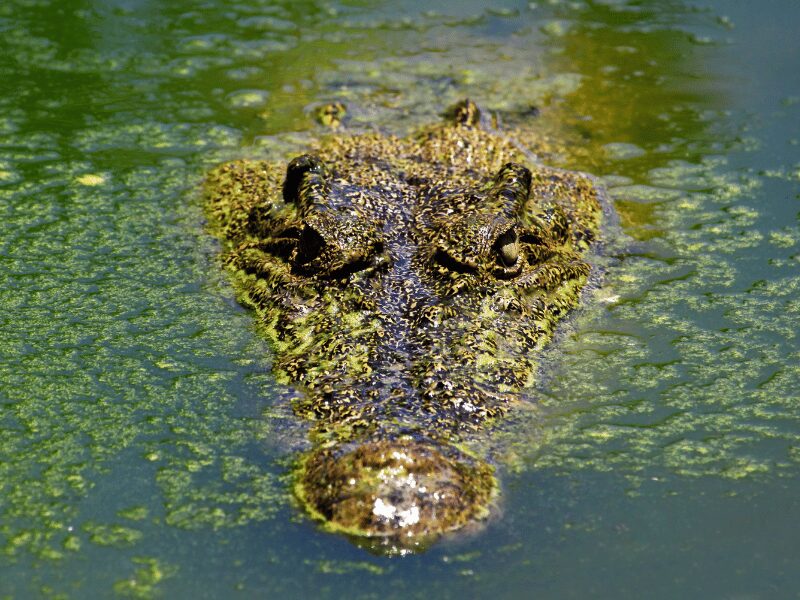
This is what makes the ambush strategy so effective. A crocodile can wait motionless below the surface for far longer than any mammal that shares its waterhole. By the time prey has relaxed and moved close to the water’s edge, the crocodile has been watching it from below for an hour.
For comparison: a trained human freediver can hold their breath for 4 to 5 minutes with practice. An untrained person begins to feel distress after 60 to 90 seconds. A crocodile is doing it for an hour without effort.
7. Their Bite Is Among the Strongest on Earth
The Nile crocodile and saltwater crocodile both produce bite forces exceeding 3,000 pounds per square inch among the highest of any living animal. For context, a lion’s bite is approximately 650 psi. A human’s is around 160 psi.
The counterintuitive detail: the muscles that close a crocodile’s jaw are immensely powerful, but the muscles that open it are weak. A reasonably strong person can hold a crocodile’s mouth shut with their hands. Researchers working with crocodiles in controlled settings use a strip of tape or a rubber band to keep the jaw closed. The asymmetry exists because crocodiles evolved to hold prey, not to open wide quickly. Their jaw is a trap, not a tool.
8. They Can Gallop on Land
Most people assume crocodiles are slow on land. In water, this is false — they swim at up to 35 km/h. On land, they are also faster than expected. Over short distances, crocodiles are capable of a true gallop, with all four feet leaving the ground simultaneously, reaching speeds of up to 17 km/h. This gait is unusual among reptiles and is typically used as a burst of acceleration rather than sustained movement.
The practical implication for anyone near a river in crocodile territory: they can cover ground quickly and are not the slow, lumbering creatures they appear when basking.
9. They Replace Their Teeth Up to 50 Times
Crocodiles have between 60 and 80 teeth at any given time. Unlike humans, they do not have a single replacement cycle. A crocodile will go through roughly 50 sets of teeth across its lifetime, replacing worn or lost teeth continuously. Over a full lifespan, a single crocodile may produce more than 3,000 teeth.
The teeth are not designed for chewing. They are designed for gripping and puncturing. Chewing does not happen.
10. They Cannot Chew
80+ teeth, none of which are used for chewing. Crocodile teeth are shaped for gripping and holding prey, not grinding. When eating, crocodiles either swallow prey whole if it is small enough, or tear off chunks using the death roll, a technique where the crocodile grips prey in its jaws, then rotates its entire body rapidly to twist off a piece. The chunks are then swallowed whole.
11. Their Stomachs Contain Stones
Crocodiles deliberately swallow stones, called gastroliths, which collect in the stomach. These serve two purposes: they help grind food that cannot be chewed, functioning like a second digestive mechanism, and they add ballast, helping the crocodile control its buoyancy underwater. A crocodile that wants to stay submerged without effort can rely on the weight of the stones to help it sink.
12. Their Immune Systems Are Exceptionally Strong
Crocodiles sustain severe wounds in territorial fights and still survive without infection. Research has found that crocodile blood contains proteins with powerful antimicrobial properties effective against bacteria, fungi, and even some viruses. Scientists have been studying these proteins as potential sources for new antibiotics, given that some are effective against strains resistant to existing drugs.
This is why a crocodile can sustain what would be a fatal wound for most animals, heal without treatment, and return to the same river the following season.
Behavior and Social Life
13. Mothers Carry Hatchlings in Their Mouths
Crocodile mothers guard their nests for the entire incubation period, which lasts around 90 days. When eggs begin to hatch, the hatchlings make a high-pitched chirping sound from inside the shell. The mother digs up the nest, gently picks up the hatchlings in her jaws the same jaws capable of 3,000 psi and carries them to the water in batches. She continues to guard the young for several months after hatching.
This is one of the most striking behavioral contrasts in the animal kingdom: a predator capable of killing buffalo displaying careful, attentive parental behavior toward animals the size of a human hand.
14. They Use Tools
Crocodiles have been documented balancing sticks and branches on their snouts during bird nesting season. Birds searching for nesting material fly close to investigate. The crocodile waits. When the bird comes within range, it strikes.
This was one of the first documented examples of tool use by a reptile, and it is seasonal crocodiles appear to do this specifically during the period when birds are actively building nests, suggesting they recognize and respond to patterns in their environment.
15. They Cry, But Not From Emotion
Crocodile tears are real. The phrase entered the language as a synonym for false emotion, and the biology behind it is worth knowing. When crocodiles are eating, pressure in their sinuses forces fluid through their tear ducts, producing visible tears. The tears have no emotional content. They are a mechanical byproduct of eating. The expression “crocodile tears” is accurate in spirit the tears appear at moments of apparent feeling, but are not connected to any emotion.
16. They Communicate Before Hatching
In the days before eggs hatch, crocodile hatchlings begin making sounds from inside the shell. The mother and other hatchlings in the same nest respond. This communication appears to synchronize hatching across the clutch a survival advantage, since a group of hatchlings arriving at the water together is safer than a lone hatchling arriving alone.
The Nile Crocodile
17. They Are the Second Largest Reptile on Earth
The saltwater crocodile, found in Southeast Asia and northern Australia, holds the record for largest living reptile, reaching lengths of up to 6 meters and weights exceeding 1,000 kg. The Nile crocodile is second: typically 4 to 5 meters long and 300 to 700 kg, with the largest documented individuals reaching 6 meters and over 900 kg.
They are found across more than 20 countries in sub-Saharan Africa, wherever rivers, lakes, or swamps provide enough food. Population estimates suggest around 250,000 to 500,000 individuals remain stable compared to many large predators, but subject to ongoing pressure from habitat loss and human conflict.
18. They Are Strategic Hunters
Nile crocodiles can spend hours floating motionless, eyes and nostrils just above the surface, watching prey approach the water. The attack is explosive a lunge covering several meters in under a second, jaws closing before the prey can react. The strategy is patience, not chase.
They are opportunistic in diet: fish, birds, antelope, and occasionally buffalo or large ungulates during river crossings. During the Great Migration crossings at the Grumeti and Mara Rivers, a single large pool may hold multiple crocodiles waiting for days for the wildebeest herds to enter the water.
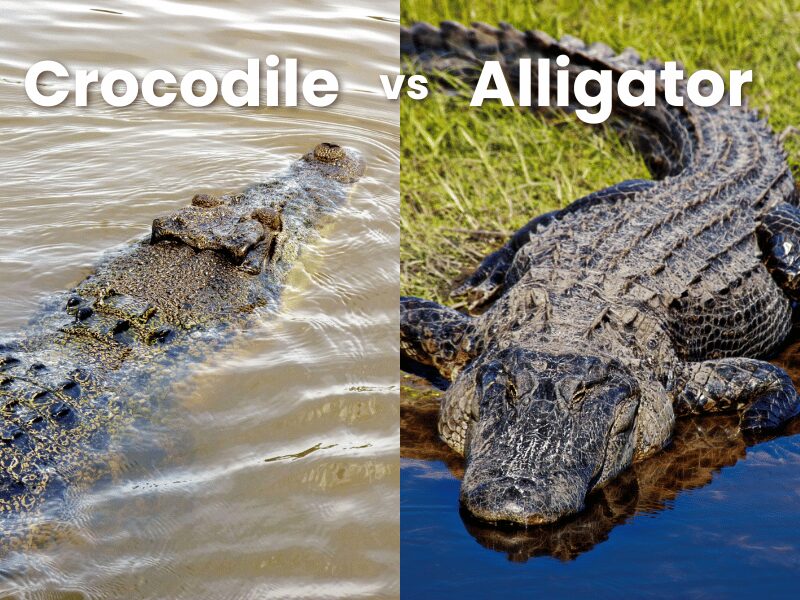
Crocodile vs. Alligator: The Quick Version
People confuse these regularly. The differences are simple once you know them.
Snout: Crocodiles have a pointed, V-shaped snout. Alligators have a broader, U-shaped snout.
Teeth: When a crocodile’s mouth is closed, the fourth tooth on the lower jaw remains visible outside the upper jaw. Alligators’ upper jaw is wider and covers the lower teeth when closed.
Habitat: Crocodiles tolerate saltwater and brackish water. Alligators prefer freshwater. Outside of South Florida and parts of Central and South America, if you are in Africa, you are looking at a crocodile.
Temperament: Crocodiles are generally considered more aggressive than alligators.
Where to See Crocodiles on Safari
Grumeti River, Tanzania
One of the best crocodile watching experiences in Africa happens during the Great Migration. As wildebeest herds cross the Grumeti River in June and July, large Nile crocodiles that have been waiting — sometimes for weeks — move in. The Grumeti crossings tend to be less photographed than the Mara River crossings in Kenya, which means the experience can feel more intimate. The western Serengeti camps positioned near the Grumeti are specifically situated to give access to these crossings.
Mara River, Kenya and Tanzania
The Mara River crossings from July through October are among the most dramatic wildlife events in Africa, and crocodiles are central to them. Large pools in the river hold multiple crocodiles at once during peak migration. The chaos of a full crossing thousands of wildebeest entering the water while crocodiles move below the surface is one of those experiences that is difficult to overstate.
Chobe River, Botswana
Boat safaris on the Chobe River give close, unhurried views of Nile crocodiles basking on sandbanks and hunting near the bank. The flat-bottomed boats get close to animals in a way that a land vehicle cannot. Chobe is also exceptional for elephants, but the crocodile viewing is some of the best in Southern Africa.
Lower Zambezi and Victoria Falls Area
The Zambezi River system supports a large Nile crocodile population. Canoe safaris on the Lower Zambezi — paddling past hippos and crocodiles at water level — are a genuine experience for travelers who want something beyond a game drive.
Ngorongoro Crater, Tanzania
The crater floor’s hippo pools and drainage channels support resident crocodile populations. Sightings here are not as dramatic as a river crossing, but the density of wildlife inside the crater means that crocodiles appear alongside lions, elephants, and flamingos in a relatively small area.
| Location | Country | Best For |
| Grumeti River | Tanzania | Migration crossings (June to July) |
| Mara River | Kenya / Tanzania | Migration crossings (July to October) |
| Chobe River | Botswana | Boat safari viewing, year-round |
| Lower Zambezi | Zambia | Canoe safaris, close-up river encounters |
| Ngorongoro Crater | Tanzania | Resident population, year-round |
Why Crocodile Conservation Matters
Crocodiles may seem fierce and unstoppable, but even these ancient survivors need protection. Habitat loss, human conflict, and hunting have been threatening them around the world.
As top predators, crocodiles play an important role in their ecosystems. Without them, entire habitats could shift, impacting countless other species, including us. Plus, preserving crocodiles means protecting wetlands, which are essential for clean water, flood control, and biodiversity.
Frequently Asked Questions
How long can crocodiles hold their breath?
An adult crocodile can hold its breath for 60 to 90 minutes at rest. In cold water, where metabolism slows further, some individuals have been documented staying submerged for up to two hours. The mechanism is cardiovascular: the crocodile slows its heart rate to 2 to 3 beats per minute and redirects blood flow away from non-essential systems, effectively powering down while waiting. A trained human freediver manages 4 to 5 minutes. A crocodile does it for an hour without apparent effort.
Are crocodiles related to dinosaurs?
Not directly, but more closely than most reptiles. Crocodiles and dinosaurs share a common ancestor — the archosaurs — a group of reptiles that dominated the Triassic period. From a taxonomic standpoint, crocodiles are more closely related to birds (which are technically living dinosaurs) than they are to lizards or snakes. The crocodile family diverged from the dinosaur lineage roughly 240 million years ago and has remained largely unchanged since.
How big do Nile crocodiles get?
Adult Nile crocodiles typically measure 4 to 5 meters in length and weigh 300 to 700 kg. The largest documented individuals have reached 6 meters and over 900 kg. The Nile crocodile is the second largest reptile on earth, behind the saltwater crocodile of Southeast Asia and Australia.
What is the difference between a crocodile and an alligator?
The fastest distinguishing feature is the snout: crocodiles have a narrow, pointed V-shape; alligators have a broader U-shape. When the mouth is closed, the crocodile’s lower fourth tooth remains visible; the alligator’s upper jaw covers it. Crocodiles also tolerate saltwater; alligators prefer freshwater. In Africa, there are no wild alligators — every large crocodilian you encounter on safari is a crocodile.
Where is the best place to see crocodiles in Africa?
The Grumeti and Mara Rivers in Tanzania and Kenya during the Great Migration (June to October) offer the most dramatic crocodile viewing, with large individuals hunting wildebeest during river crossings. The Chobe River in Botswana is excellent for boat-based viewing year-round. The Lower Zambezi in Zambia is another strong option, particularly for canoe safaris at water level.
How long do crocodiles live?
Nile crocodiles commonly live 70 to 100 years in the wild. Some captive individuals have been documented living longer. Their longevity is connected to their low metabolic rate, crocodiles conserve energy so efficiently that they can survive up to a year without food in extreme conditions.
Final Words
If reading all these fun facts on crocodiles has made you want to see them up close, why not plan a trip to Africa? You can book your safari with Good Earth Tours and witness these incredible creatures in their wild, natural glory.